
How fast should a dealership answer an internet lead?
Answer while the buyer still has the phone in their hand. Here's where the time goes at most stores, how to measure your own speed to lead, and how to get faster without getting sloppy.
Lead response6 min read
Why the first few minutes decide so much
A buyer who fills out a form on your website, or on a third-party listing site, is almost always doing it from a phone, and almost never doing it only once. They usually have a few tabs open, a few similar vehicles saved, and a few stores they've asked the same question.
When the lead comes in, that customer is at peak interest. They're looking at the car, they have a question in their head, and the phone is in their hand. If your reply lands then, you're part of the decision. If it lands after lunch, you're competing with whoever answered first, and with the customer's fading memory of what they even asked.
You don't need a study to see this. Think about the last time you asked a few businesses for a quote on something. You probably went with one of the first ones that answered with something real. Car buyers do the same.
What counts as responding to an internet lead
Most CRMs send an automatic email the moment a lead arrives. That's fine as a receipt, but customers know a canned email when they see one, and plenty of them never open it. If you start your stopwatch there, you'll think you're fast when you aren't.
Count the time to the first message that does at least one of these:
- Answers the question the customer actually asked: is it still there, what's the price, can I see it on Saturday.
- Confirms the specific vehicle they looked at, by stock number or trim.
- Asks one clear question that moves things forward.
A text usually beats an email for that first message because it gets read. A phone call is great when the customer picks up, but many people won't answer an unknown number, and a voicemail asks them to do the work. A lot of stores now text first and call when the customer invites it. Either way, make sure you have consent to text under the rules where the customer lives.
Where the time actually goes
When managers pull their response times for the first time, the result is usually worse than they expected. The delay is rarely one lazy rep. It's the handoffs.
- Routing. The lead lands in a shared inbox, or a round-robin assigns it to someone who's on a test drive, at lunch or off today.
- Lookup. The rep has to find the car, check it's still in stock and confirm the listed price before writing anything.
- Hesitation. Nobody wants to send the wrong price, so the lead waits for a manager to look at it.
- Peak hours. Leads bunch up on weekday evenings and weekends, when the floor is busiest.
- After hours. Anything that arrives after close sits until morning, then competes with the morning's fresh leads.
Each of these is small. Stacked together, they turn a quick reply into a slow one. If you can only fix one thing this month, fix routing. A lead should never be assigned to someone who isn't on the floor right now.
How to measure your dealership's speed to lead
You can do this with an export from your CRM and an afternoon.
- 1Pull last month's internet leads with the time each one arrived.
- 2For each lead, find the time of the first real reply: a personal text, a call that connected or a personal email. Skip the auto-responder.
- 3Split the list into leads that arrived while you were open and leads that arrived after close.
- 4Look at the median for each group. An average gets dragged around by a handful of leads that sat for days. The median tells you what a typical customer experienced.
- 5Sort by lead source and by hour of the day. You'll usually find a source or a time slot where leads sit much longer than the rest.
Do it again next month with the same method. The trend matters more than any single result, and the slow time slots tell you where to put coverage.
How to get faster without getting sloppy
The risk with pushing for speed is that reps start firing off replies that say the wrong thing. A fast wrong answer is worse than a slower right one, because the customer screenshots it and brings it in.
A fast wrong answer is worse than a slower right one, because the customer screenshots it and brings it in.
A few habits keep speed and accuracy together:
- Quote the listed price only. Discounts, payments and financing come from the sales manager.
- Confirm the exact vehicle before saying it's available.
- Never promise when someone will call or when a manager will get back to them. Say who handles the next step, not when.
- Ask one question per text. The easiest first question is whether they're local or coming from out of the area, because the answer tells you how to plan the visit.
- Send service requests to the service department with its direct number. Don't try to sell a car to someone booking an oil change.
For wording and templates, see what to say in the first text to a car buyer.
What about leads that come in after you close?
Evening and weekend leads are where most stores lose the most time, because nobody is there to answer. There are good reasons not to text a brand-new lead in the middle of the night, so the goal is to be first in line when your texting hours open, and to answer quickly when a customer writes back. We cover the details in the leads that arrive after you close.
What fast looks like at one dealership
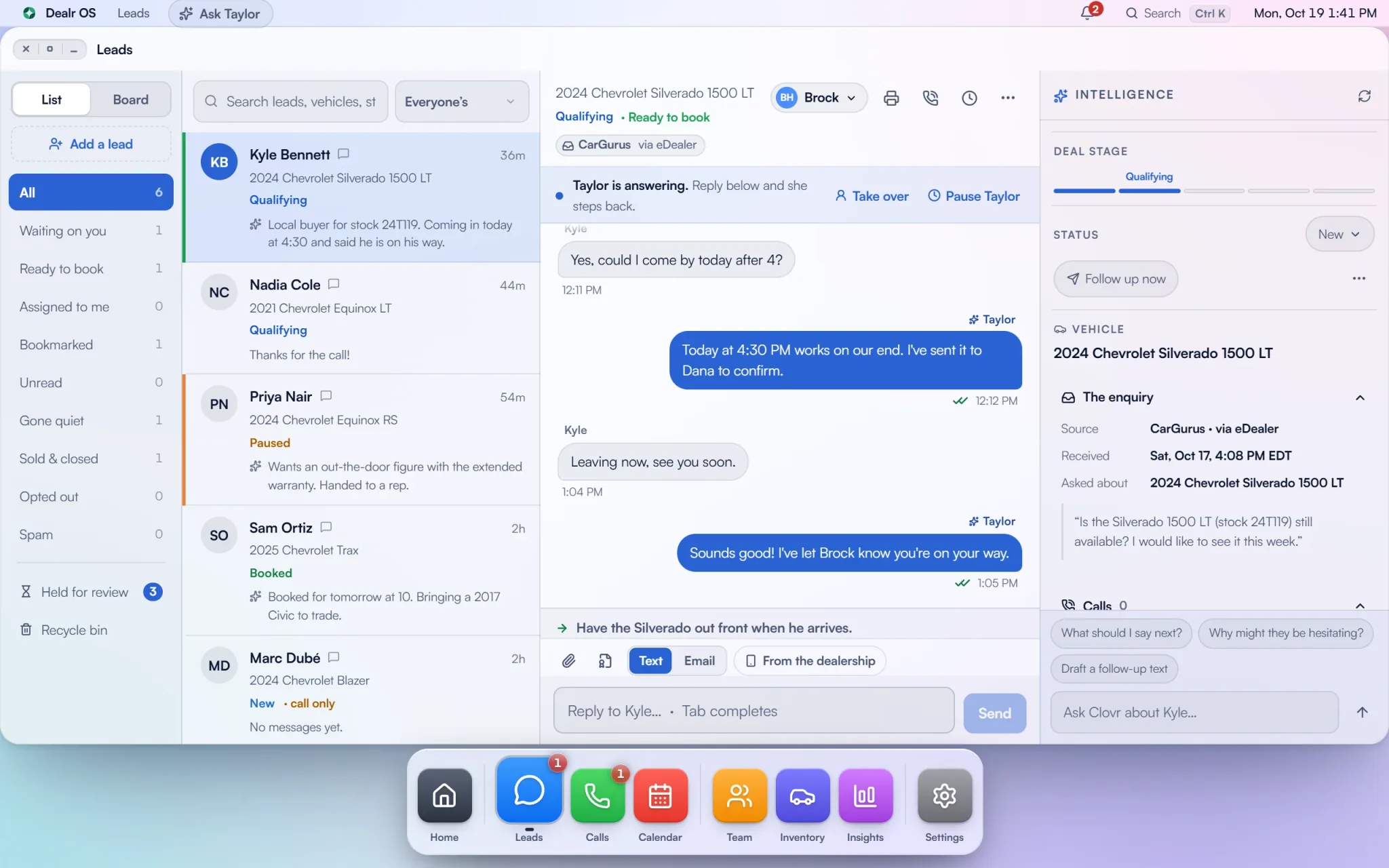
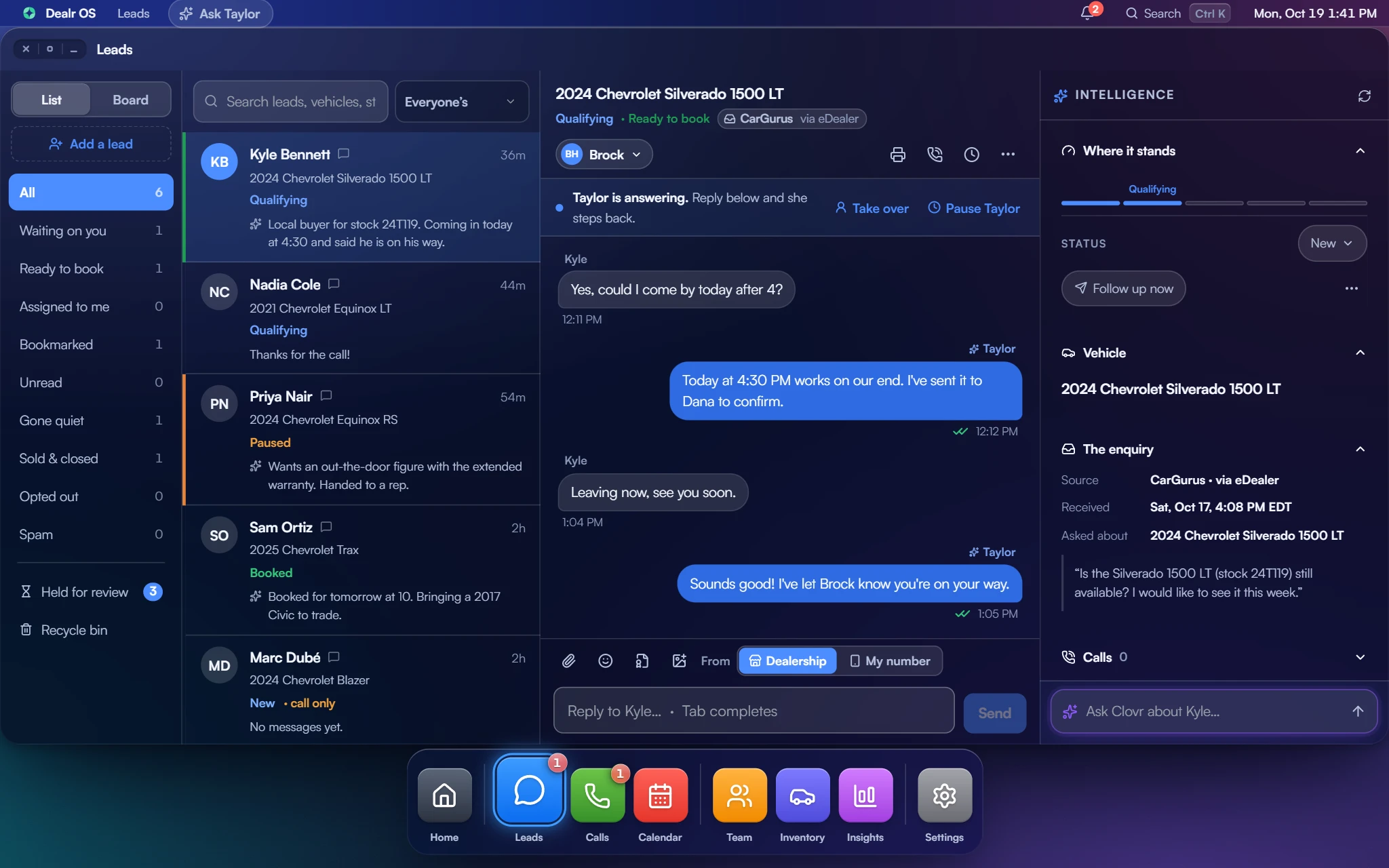
At Parry Sound Chevrolet Buick GMC in Ontario, Taylor, the assistant in Clovr Dealr, texts internet leads back on the store's behalf. Across 195 internet leads from July 11 to October 17, 2026, her first text during texting hours went out in a median of 5 seconds, and 94% went out in under 10 seconds. When customers texted back, she replied in a median of 2.3 minutes, and 78% of the leads she texted wrote back. The full breakdown is in the Parry Sound case study.
Taylor never pretends to be human, gives the listed price only, and hands the lead to a rep when it's time for a person. If you'd like to see how that would work with your own process, book a demo.
Speed is the job dealership AI does best. See how car dealerships use AI, or the whole dealership AI guide.
Questions dealers ask
How fast should a dealership respond to an internet lead?
As fast as you can send a useful reply, ideally while the customer is still on their phone. The time to the first real answer matters more than the time to an auto-reply email.
Does an automatic email count as a response?
Not really. It confirms the lead was received, but it doesn't answer the customer's question. Measure the time to the first message that does.
Should we call or text an internet lead first?
Many stores text first because a text gets read, while a call from an unknown number often goes unanswered. Call when the customer asks for it or once a conversation is going, and make sure you have consent to text where they live.
How do we measure our dealership's response time?
Export last month's leads, find the time from arrival to the first real reply for each one, and look at the median separately for business hours and after hours. Repeat it monthly with the same method.