Car dealership lead management: a simple system for every lead
Leads slip through the gaps between people. Here's a simple system that gives every internet lead an owner, a next step and a clear ending.
Sales process5 min read
What lead management means at a dealership
Lead management is the routine that carries an internet lead from the moment it arrives to the moment it ends, whether that's a sale, a polite no or an opt-out. Your CRM holds the records. The system itself is a set of habits: who answers, who owns the lead, what happens next and when it's done.
When it breaks, it breaks in the gaps. A lead source emails an inbox nobody checks. A round-robin hands a lead to someone who's off today. A follow-up ignores yesterday's phone call. A lead sits in "working" for months because nobody closed it.
How to get every lead into one place
List every place a lead can come from: your website forms, manufacturer programs, third-party listing sites, chat, social media messages and phone calls. Then check where each one lands.
- Send a test lead from each source and confirm it reaches your CRM with the customer's name, contact details and the vehicle they asked about.
- Find the sources that go to a personal inbox or a shared email address, and reroute them.
- Merge duplicates, so a customer who writes in twice has one owner.
- Repeat the test every month, because lead forms change without anyone telling you.
Answer every lead with something useful
An auto-reply email confirms you received the lead, and that's all it does. The first real reply answers what the customer asked, confirms the exact car and asks one easy question, such as whether they're local or coming from out of the area.
Measure the time from arrival to that first real reply, and look at business hours and after hours separately. Leads that arrive overnight should be answered as soon as your texting hours open, oldest first. We go through the measuring in how fast should a dealership answer an internet lead.
Give every lead one owner and a next step
A lead with two owners has none. Assign each lead to one person who is working that day, and show the owner on the lead where everyone can see it.
Then write the next step on it: what happens next and who does it. "Send photos of the cargo area" is a next step. "Follow up" isn't. A short set of stages helps everyone read the board the same way:
- New: arrived, not yet answered.
- Talking: the customer has replied and a conversation is going.
- Visit booked: a manager has approved the time.
- Visited: they came in, and the next step is on the lead.
- Sold or Closed: with a reason either way.
A lead with two owners has none.
When a lead changes hands, the new owner reads the whole thread first and tells the customer who they're dealing with now.
Hi Omar, it's Alex at Northbrook Motors. Sam is off today, so I'm looking after you. I've read your messages about the grey Sierra. Are you still hoping to see it Saturday?
Yes, Saturday morning if that works.
Let me confirm Saturday morning with my manager, and I'll text you back.
Follow up until you get an answer
Customers go quiet for ordinary reasons: work, family, another store they're talking to. Good follow-up starts close together and spreads out, moves between text, phone and email, and gives the customer something new each time, like a photo, an answer or a real change in the listed price.
Log every call on the lead, so the next text reflects what was said. A text asking a question the customer already answered on the phone tells them nobody wrote it down. The full cadence is in how to follow up with car leads that went quiet.
Close leads on purpose
Leads that never end clutter the CRM and hide the ones that are still alive. Close each one with a reason:
- Bought here, or bought elsewhere.
- Opted out, applied across the whole store.
- Not in the market yet. If they gave you a timeframe, put a date on the lead to check back.
- A service request, passed to the service department with its direct number.
- Wrong number or duplicate.
Consent sets a limit too. In Canada, an inquiry gives implied consent under CASL for 6 months, and a purchase gives implied consent for 2 years. In the US, follow your consent records, the TCPA and your state's rules.
A weekly lead management check
Pick a regular time each week and go through the same list:
- 1Median time to the first real reply, for business hours and after hours.
- 2Leads with no owner, or an owner who isn't working this week.
- 3Leads with no next step written on them.
- 4Threads where the customer wrote last and nobody answered.
- 5Visits booked, approved and kept.
- 6Leads closed this week, and the reasons.
- 7A handful of conversations, read from start to finish.
The numbers tell you where to look, and reading the conversations tells you what to fix.
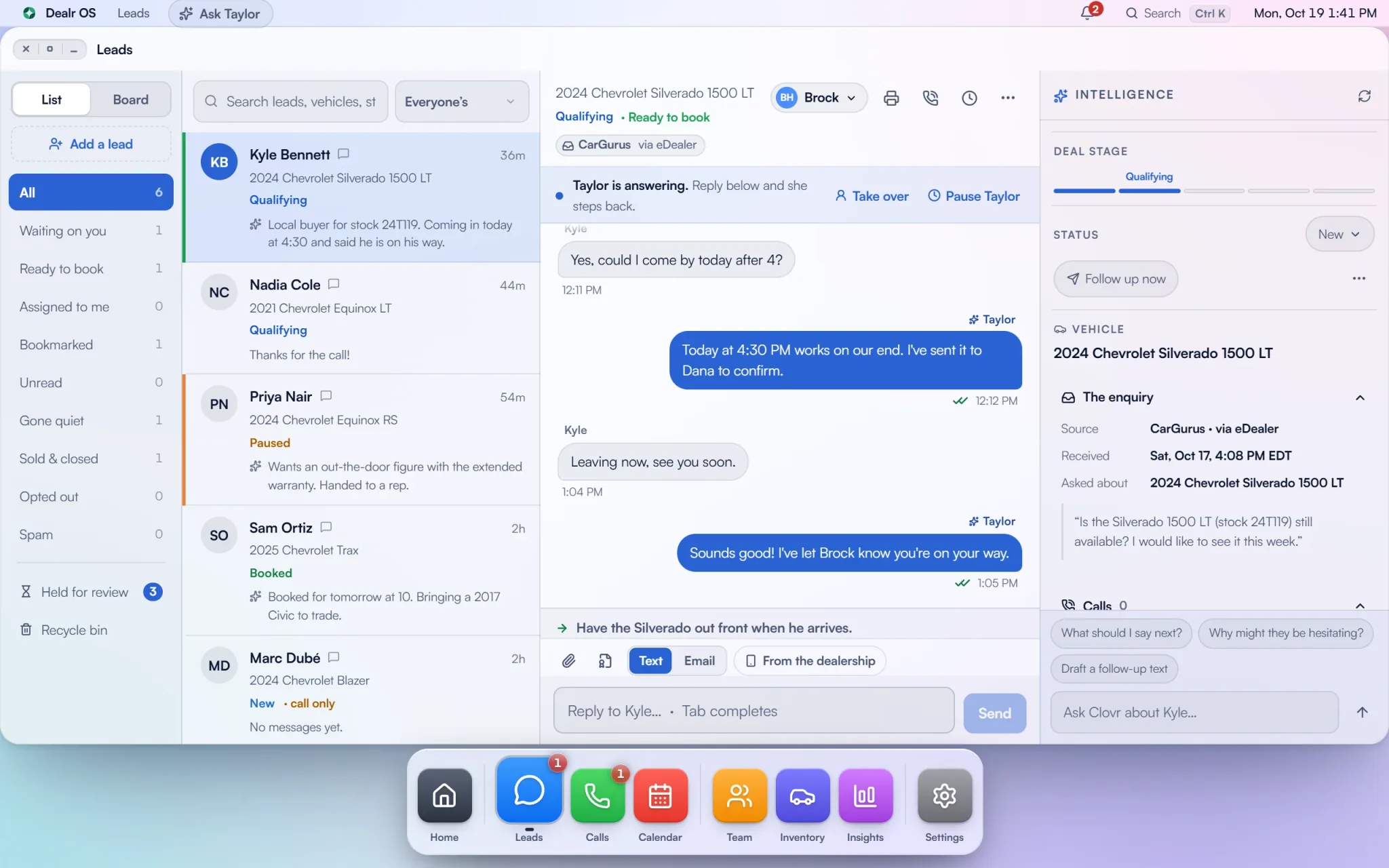
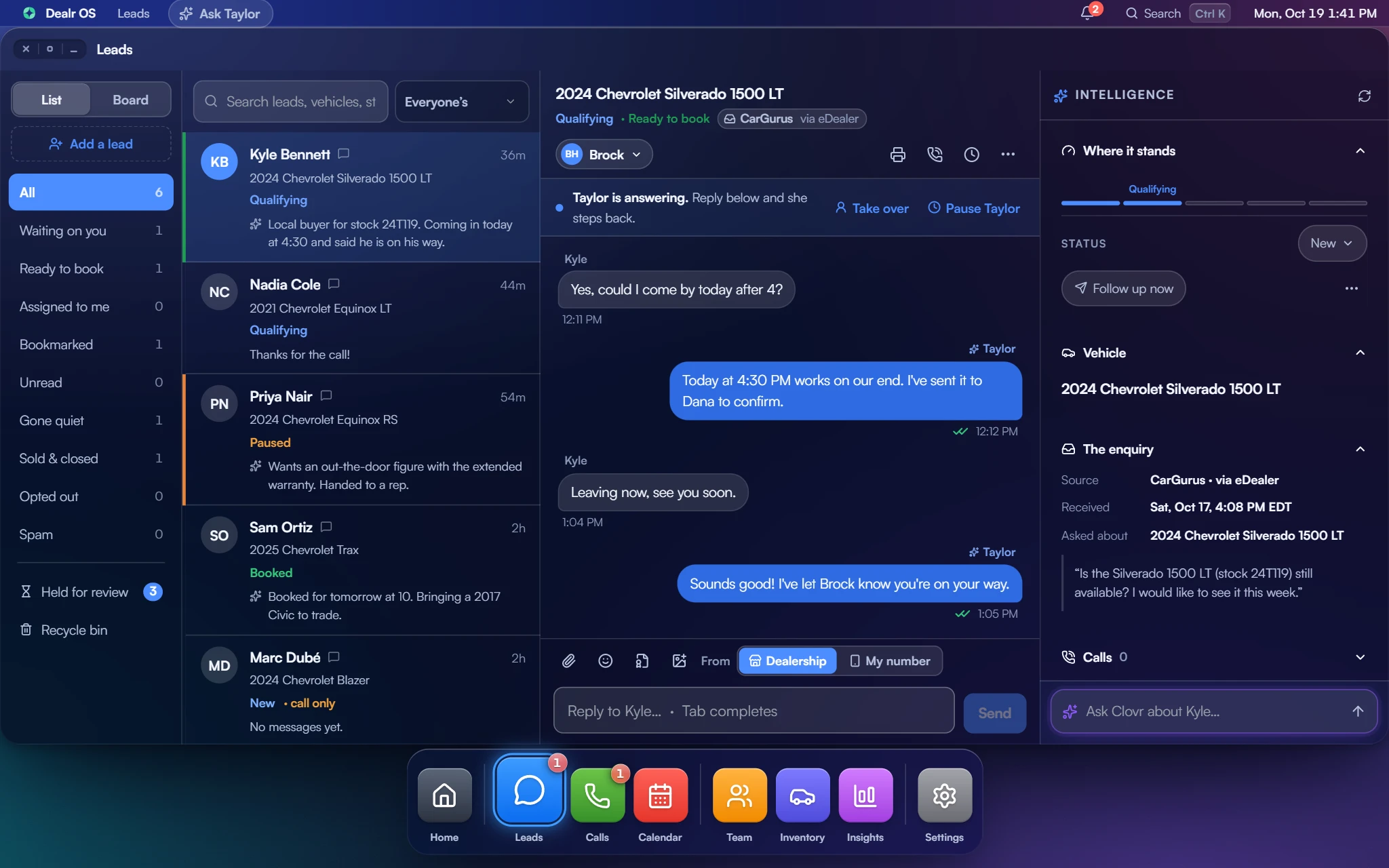
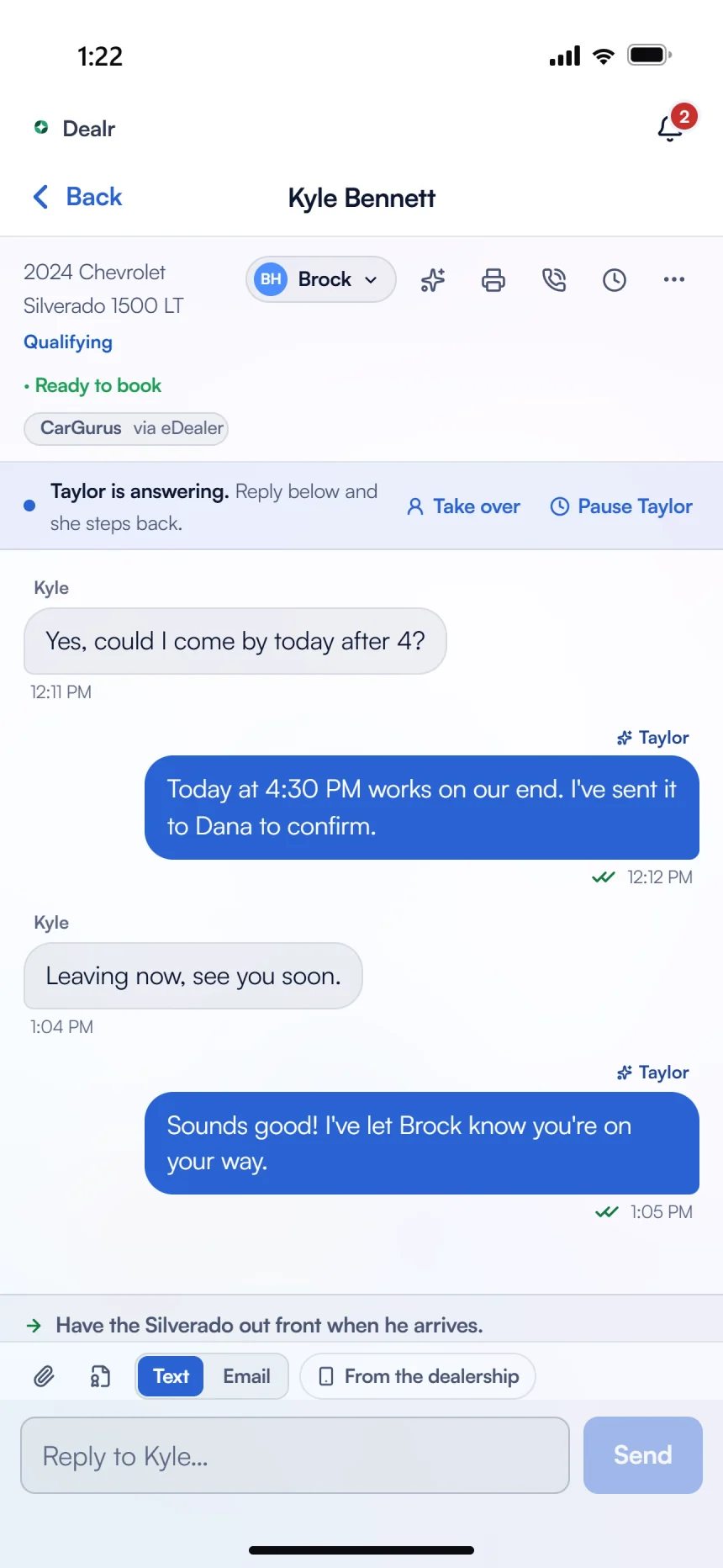
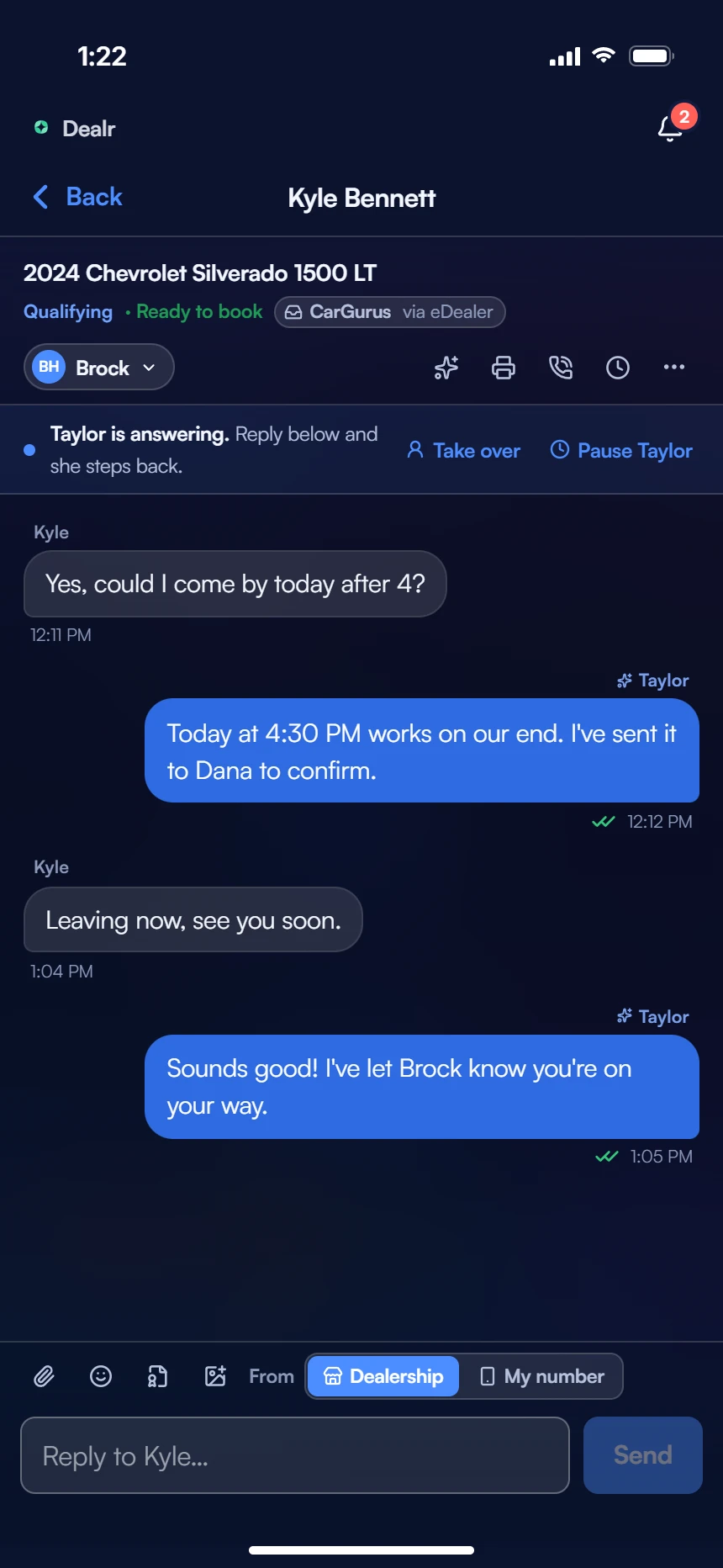
Clovr Dealr takes on the first reply and the early back-and-forth. Its assistant, Taylor, texts internet leads back within seconds during the store's texting hours, asks whether they're local or out of the area, books visits for a manager to approve and hands each lead to a rep. At Parry Sound Chevrolet Buick GMC, across 195 internet leads from July 11 to October 17, 2026, her first text during texting hours went out in a median of 5 seconds, and she replied to customer texts in a median of 2.3 minutes. The details are in the Parry Sound case study, and you can try it on a demo.
Where AI fits in lead management: how car dealerships use AI, and the dealership AI guide.
Questions dealers ask
What is lead management at a car dealership?
The routine that makes sure every lead is captured, answered, assigned to one owner, followed up and closed with a reason. Your CRM holds the records, and your team's habits do the rest.
Who should own an internet lead?
One person at a time, and someone who is working that day. When ownership changes, the new owner reads the whole thread and tells the customer.
When should a dealership close a lead?
When the customer buys, buys elsewhere, opts out or says they aren't in the market, or when your consent to contact them runs out. Record the reason, so nobody restarts the conversation by mistake.
What should a dealership check in its lead management each week?
Time to the first real reply, leads with no owner or next step, customers whose last message got no answer, and how many booked visits showed up.